
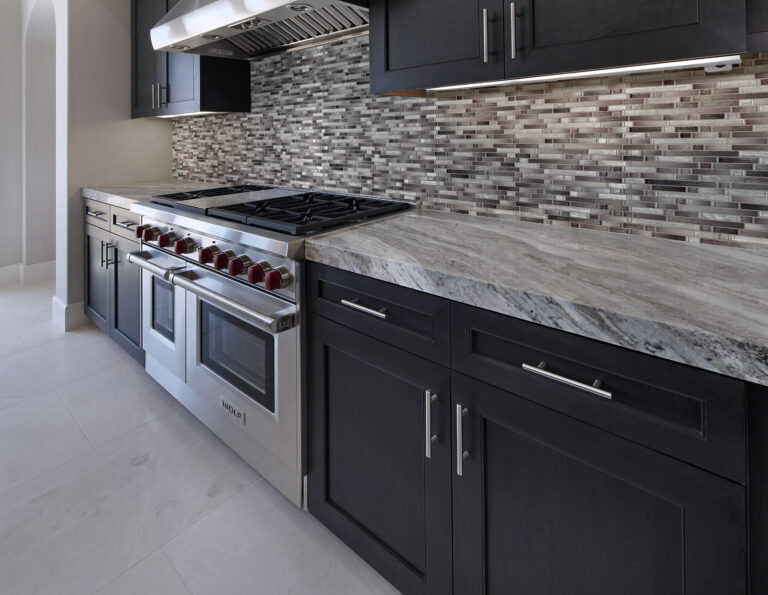
When choosing new countertops, most homeowners start with material, color and veining. But there is another decision that can affect the appearance, fabrication, installation and overall cost of your project: countertop thickness.
When considering your options, it’s essential to weigh the differences between 2cm vs 3cm countertops to determine the best fit for your needs.
Two of the most common slab thicknesses you’ll encounter are 2cm and 3cm countertops. A 2cm slab is approximately ¾ inch thick, while a 3cm slab is approximately 1¼ inches thick.
So, which countertop thickness is better?
Understanding the implications of choosing between 2cm vs 3cm countertops can help clarify which thickness aligns with your design goals.
At Tops Countertops, we don’t think there is one answer that works for every kitchen or bathroom. The right thickness depends on the material you select, your cabinetry, countertop layout, edge profile, overhangs, backsplash design and how the finished surface will be used.
Understanding those differences before material is ordered can help you make a better decision for both the look and function of your project.
What Is the Standard Countertop Thickness?
For quartz and many natural stone countertops, 2cm and 3cm are two common slab thicknesses.
In residential kitchens, 3cm is a common choice for perimeter countertops and kitchen islands. A 2cm slab may be considered for bathroom vanities, backsplashes, vertical applications and designs where a thinner profile is preferred.
The most obvious difference is visual.
A 2cm countertop creates a thinner, more streamlined profile. A 3cm countertop has a thicker, more substantial appearance that many homeowners are familiar with in kitchens.
However, countertop thickness isn’t only about appearance. It can also affect weight, support, fabrication, edge options, material availability and how efficiently slabs can be used throughout your project.
That’s why we recommend looking at your entire project instead of choosing 2cm or 3cm based on one factor.
If this is your first countertop project, our Countertop Buying Guide walks through the complete process, from initial measurements and material selection through template, fabrication and installation.
Is 3cm Stronger Than 2cm?
A thicker slab generally provides greater structural capacity, but that doesn’t mean a 2cm countertop should automatically be considered an inferior option.
When comparing two thicknesses of the same quartz product, you’re still selecting the same engineered surface. What changes is the thickness of the slab and how that thickness affects weight, fabrication and structural requirements.
From our perspective as fabricators, proper fabrication, support and installation are just as important as thickness.
Ultimately, the choice between 2cm vs 3cm countertops should reflect your personal style and functional requirements for your space.
A countertop with a sink or cooktop cutout, large overhang or seating area has different requirements than a smaller bathroom vanity. Cabinet construction, seams, material and the overall layout matter too.
This is why we don’t recommend choosing 3cm simply because “thicker must be better.”
The better question is: Which thickness makes the most sense for your material and your specific project?
What We Look at Before Recommending 2cm or 3cm
At Tops Countertops, thickness isn’t a decision we make in isolation.
Before recommending 2cm or 3cm, we look at your:
- Selected countertop material
- Available slab dimensions and thickness
- Kitchen or bathroom layout
- Cabinetry
- Sink and cooktop cutouts
- Seams
- Overhangs and support requirements
- Edge profile
- Island design
- Full-height backsplash plans
- Overall material yield
Two homeowners can select the same quartz color and still receive different recommendations because their projects are different.
Our recommendation starts with the project, not simply the thickness.
How Does Countertop Thickness Change the Look?
Countertop thickness can make a noticeable difference in the finished design.
The Look of 2cm Countertops
A 2cm countertop creates a slimmer edge profile that works especially well in contemporary, minimalist and streamlined spaces.
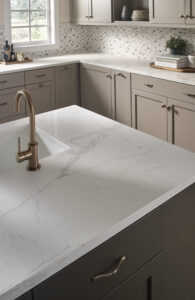
It can also be a great option for bathroom vanities or projects where you don’t want the countertop edge to feel visually heavy.
The Look of 3cm Countertops
A 3cm countertop has a thicker, more substantial appearance. It’s commonly used in residential kitchens and can complement larger islands, cabinetry and open-concept spaces.
There isn’t a right or wrong look. Countertop thickness is another design decision, much like your cabinetry, hardware, backsplash and edge profile.
Does Countertop Thickness Affect Edge Options?
Yes. The thickness of your slab can influence both the appearance of your countertop edge and which edge profiles make sense for your material and design.
Simple edge profiles can work beautifully with different slab thicknesses. At Tops Countertops, options such as Eased, ¼ Radius, Pillow and Ogee allow the edge itself to become part of the overall countertop design.
But the visible edge of a countertop doesn’t always have to match the actual thickness of the slab.
What Is a Mitered Edge?
A mitered edge is a fabrication technique that can create the appearance of a much thicker countertop without requiring the entire slab to be that thickness.
Instead of simply exposing the original 2cm or 3cm slab edge, pieces are precisely cut and joined at an angle so the material continues down the face of the countertop. When properly fabricated, the pattern or veining can visually continue across the transition, creating the appearance of one substantial piece of material.
This makes mitered edges especially useful when a homeowner wants a thicker, more dramatic countertop profile.
For example, selecting a 2cm or 3cm slab doesn’t necessarily mean the finished edge has to appear only 2cm or 3cm thick. Depending on the material and project, a mitered edge can be fabricated to create a deeper finished profile.
We often see this approach considered for large kitchen islands, waterfall designs and contemporary kitchens where the countertop is intended to become a major visual feature.
When Do We Recommend Considering a Mitered Edge?
We recommend discussing a mitered edge when you love a particular material but want more visual thickness than its standard slab profile provides.
It can also be a great design option when you want:
- A thicker-looking kitchen island
- A bold, substantial countertop profile
- A contemporary or architectural appearance
- A thicker edge without requiring the entire countertop to be that thickness
- A design that coordinates with a waterfall edge
However, a mitered edge requires additional fabrication compared with a standard edge profile. The selected material, pattern, veining, layout and desired finished thickness all need to be considered.
For materials with noticeable movement or veining, we also pay attention to how that pattern transitions across the miter. The goal isn’t simply to make the countertop look thicker. It’s to make the finished edge look intentional.
This is another reason we recommend choosing countertop thickness and edge profile together rather than treating them as separate decisions.
Our Countertop Buying Guide covers additional edge and design considerations to think about while planning your project.
2cm vs. 3cm Quartz Countertops
If you’re considering quartz countertops, you’ll find different thickness options depending on the manufacturer and color.
3cm quartz countertops are commonly selected for kitchens, islands and other primary work surfaces. They provide a thicker profile and greater structural capacity.
2cm quartz countertops provide a slimmer appearance and can work well for bathroom vanities, select countertop applications and vertical surfaces.
One thing we don’t recommend is selecting 2cm solely because you assume it will make the entire project significantly less expensive.
A finished countertop project involves much more than the price of the raw slab.
Material availability, fabrication, support, edge details, installation, slab dimensions and material yield can all affect the final price.
This is why the finished cost difference between 2cm and 3cm can sometimes be much smaller than homeowners expect.
Is 2cm Cheaper Than 3cm?
It can be at the material level, but that doesn’t automatically make it less expensive for the finished project.
Your countertop quote can be influenced by the material selected, number of slabs required, fabrication, sink and cooktop cutouts, edge details, seams, support requirements, installation and backsplash material.
One factor homeowners don’t always think about is slab yield.
Slab yield refers to how efficiently we can lay out the different pieces of your project across the available slab material.
Imagine one material appears less expensive per square foot. If its slab dimensions or your project layout mean an additional slab is required to complete the kitchen, the supposedly cheaper option may not result in the lower overall project price.
Sink openings, cooktop cutouts, seams, pattern or veining direction, islands, waterfall panels and full-height backsplashes can all affect how efficiently material can be used.
At Tops Countertops, we recommend looking at the entire project cost and material layout, not simply comparing the price of 2cm against 3cm.
You can also browse our current slab inventory to see the materials currently available through Tops. If you don’t find the color or material you’re looking for, that doesn’t necessarily mean your options end there. We also work with a network of stone and countertop distributors that offer additional quartz, granite, quartzite and other surface options.
Availability can vary by material, color, slab size and thickness, so if you have a specific 2cm or 3cm material in mind, our team can help determine what’s available for your project.
Does Thickness Matter for a Full-Height Backsplash?
Absolutely, especially if you plan to continue your countertop material onto the wall as a full-height backsplash.
Your countertops and backsplash do not necessarily need to be the same thickness.
For example, a kitchen could have 3cm quartz countertops with a 2cm full-height quartz backsplash in the same color.
A backsplash is a vertical application rather than a primary working surface. Using thinner material can reduce the amount of weight being installed vertically and creates a slimmer profile against the wall. A 2cm backsplash also projects slightly less from the wall than 3cm material.
However, there is another side of this decision that homeowners don’t always consider: material usage and cost.
Can 3cm Countertops With a 2cm Backsplash Cost More?
Potentially, yes.
This is an important detail to consider before ordering material.
Let’s say you’ve selected a quartz color for your kitchen. Your countertops will be fabricated from 3cm quartz, but you’d like the full-height backsplash fabricated from the exact same color in 2cm.
Now we’re potentially working with two different material thicknesses.
Depending on the manufacturer, color, slab dimensions and amount of backsplash required, we may need material in both 3cm and 2cm to complete the project.
That can affect your overall cost.
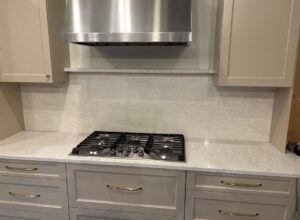
For example, there may be enough 3cm material remaining after laying out your countertops to fabricate some or all of your backsplash. In that situation, ordering additional 2cm material solely to create a thinner backsplash may not be the most cost-effective choice.
On another project, the layout and amount of backsplash required may make separate 2cm material a better option.
We recommend discussing your countertops and full-height backsplash together before material is ordered.
When we’re reviewing a project with a full-height backsplash, we prefer to know that from the beginning so we can look at the countertops and backsplash as one fabrication plan.
Sometimes mixing thicknesses makes sense. Sometimes it means purchasing additional material that wouldn’t otherwise be necessary.
Planning both together gives us an opportunity to evaluate slab sizes, material availability and overall yield before recommending the most practical option.
Why Material Yield Matters
This is one of those parts of countertop fabrication that isn’t always visible when you’re shopping for material, but it can make a real difference.
We aren’t simply calculating the square footage of your countertops and ordering that exact amount of stone.
We have to determine how every piece fits onto the available slabs while accounting for slab dimensions, seams, veining or pattern direction, cutouts, fabrication requirements and the overall design.
That becomes especially important when a project includes a large kitchen island, waterfall edges or full-height backsplash.
Sometimes changing a design detail or thickness can improve material usage. Other times, it can mean another slab is required.
That’s why we recommend getting your fabricator involved early. We can help you understand the whole project, not just the material price.
What About 2cm vs. 3cm Granite and Natural Stone?
Countertop thickness isn’t only a quartz conversation.
Granite countertops, quartzite countertops and other natural stone materials may also be available in different thicknesses.
Natural stone introduces another important consideration: you’re selecting an individual slab created by nature.
Slab dimensions, thickness, color, movement and availability can vary.
For natural stone, we recommend looking at the actual slabs available before deciding that your project absolutely needs to be 2cm or 3cm.
A particular granite or quartzite you love may be readily available in only one thickness.
We also recommend hand-selecting natural stone whenever possible. Seeing the full slab gives you a much better understanding of its color, movement and natural variation than relying on a small sample alone.
You can browse our live countertop inventory before visiting our Lacey showroom.
Which Countertop Thickness Is Best for a Kitchen Island?
Kitchen islands deserve extra consideration when choosing countertop thickness, especially when the design includes seating, overhangs, a sink, cooktop or waterfall edge.
For larger islands, we generally recommend starting the conversation with 3cm material, then evaluating the material, dimensions, cabinetry, cutouts and support requirements.
At Tops Countertops, those requirements vary by material and layout. Our guidelines allow 3cm natural stone overhangs up to 10 inches without additional support when there are no cutouts, while 3cm quartz may allow more depending on countertop depth and manufacturer specifications. If an overhang contains a cutout, additional support is required.
This is why we recommend evaluating the actual island design rather than relying on one standard overhang measurement.
Why Final Template Measurements Matter
Initial measurements are extremely helpful for preparing your countertop estimate, but they aren’t what we use to fabricate the finished countertops.
Once your project is ready, our team uses laser templating technology to collect the final measurements needed for fabrication.
At template, details such as overhangs, corners, sink placement, faucet holes, appliances and other design decisions are finalized.
That’s why we recommend making thickness, backsplash and major design decisions early while leaving final fabrication measurements to the templating process.
You can learn more about what to expect before template and installation in our Countertop Buying Guide.
Is 2cm or 3cm Better for a Bathroom Vanity?
Both can work beautifully.
Bathroom vanities are one application where 2cm countertops can be especially appealing. The thinner profile creates a clean, streamlined appearance and weighs less than the equivalent 3cm slab.
If you prefer the more substantial appearance of 3cm, however, there’s no reason to assume it should only be used in a kitchen.
For bathroom countertops, we recommend considering the vanity design, sink configuration, selected material, material availability and the finished look you want to achieve rather than choosing thickness based on one rule.
For smaller vanity projects, it can also be worth checking our countertop remnants, which can provide another way to find stone for smaller spaces.
What About Porcelain Countertop Thickness?
Porcelain works differently than traditional quartz, granite and quartzite.
Porcelain countertops are available in thinner formats and can be used for countertops as well as vertical applications.
Because porcelain fabrication, edge design and installation requirements are different, we don’t recommend applying all of the traditional 2cm vs. 3cm rules directly to porcelain.
If you’re considering this material, start with our guide to everything you need to know about porcelain countertops. We’ll also be covering porcelain slab thickness and when different thicknesses make sense in a separate guide.
So, Should You Choose 2cm or 3cm Countertops?
There isn’t one countertop thickness that’s right for every kitchen or bathroom.
If you want a slimmer, more streamlined profile, 2cm may be exactly what your design needs.
If you prefer a thicker appearance or have a larger kitchen island or more complex countertop layout, 3cm may make more sense.
But thickness is only one part of the project.
At Tops Countertops, we look at your selected material, cabinetry, layout, edge profile, overhangs, sink and cooktop cutouts, backsplash plans and how the space will actually be used before making a recommendation.
That’s one of the biggest advantages of working directly with a countertop fabricator.
You’re not simply choosing 2cm vs. 3cm based on which one sounds better. You’re choosing the material and thickness that make the most sense for your actual space.
Ready to start planning your project? Browse our current countertop inventory, experiment with materials using our Countertop Visualizer, or schedule an appointment at our Lacey showroom to compare materials and options in person.
Frequently Asked Questions About Countertop Thickness
How thick are standard countertops?
Two common countertop thicknesses are 2cm, approximately ¾ inch, and 3cm, approximately 1¼ inches. Availability depends on the material, color and manufacturer.
Is 2cm or 3cm better for quartz countertops?
Neither is automatically better. 3cm is commonly used for kitchen countertops and islands, while 2cm provides a slimmer profile and can work well for vanities, backsplashes and other applications. We recommend selecting thickness based on the entire project rather than appearance alone.
Is 3cm quartz stronger than 2cm quartz?
A 3cm slab provides greater structural capacity because of its additional thickness. However, proper fabrication, support and installation remain important regardless of the thickness selected.
Can you use a 2cm backsplash with 3cm countertops?
Yes. A kitchen can combine 3cm countertops with a 2cm backsplash in the same material. However, using two different thicknesses may require additional material, so we recommend evaluating the entire slab layout and project cost before ordering.
Is 2cm cheaper than 3cm?
Not necessarily when you compare the finished project. Material pricing, slab dimensions, slab yield, support requirements, fabrication and the number of slabs required can all affect the final cost.
Does countertop thickness affect edge profiles?
Yes. Thickness changes the appearance of the finished edge and can influence which decorative edge profiles are practical for your selected material.
Which countertop thickness is best for a kitchen island?
3cm is commonly used for kitchen islands, especially larger designs or islands with seating and overhangs. We recommend evaluating the material, island dimensions, cabinetry and support requirements together before making the final decision.
Does countertop thickness matter for a full-height backsplash?
Yes. A thinner backsplash can reduce weight and create a slimmer profile against the wall. However, slab availability, material yield and whether another thickness needs to be ordered should also be considered.